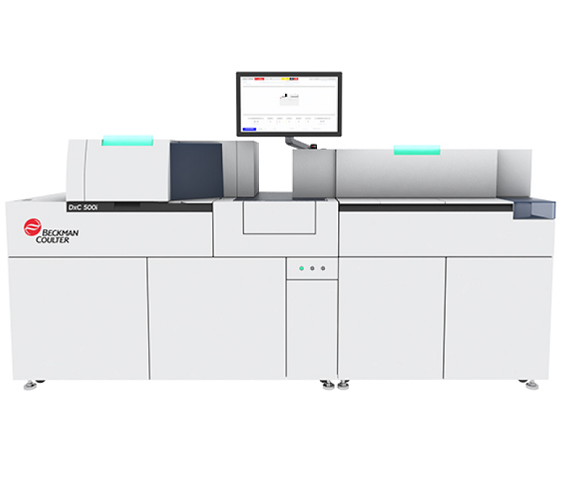
Analytical method
|
Fully automated, random-access integrated system with clinical chemistry and immunoassay modules |
Analytical principles
|
Spectrophotometry, potentiometry, and chemiluminescence |
Assay types
|
- Chemistry: Endpoint, rate, fixed point, indirect ISE
- Immunoassay: Competitive assay, Sandwich assay, and Antibody detection assay
|
Analytical method
|
- Chemistry: Colorimetry, turbidimetry, latex agglutination, and indirect ISE
- Immunoassay: Paramagnetic coated antibody/antigen
|
Chemistry menu capacity
|
>170 preprogrammed assays currently available |
Throughput
|
- 400 photometric tests per hour, up to 800 with ISE
- 100 immunoassay tests per hour (one-step assays)
- ISE maximum test per hour: 600 if ISE only
- HbA1c maximum tests per hour: 65 if HbA1c only
|
Sample types (assay dependent)
|
Serum, plasma, urine, CSF, whole blood, and amniotic fluid |
Sample management/capacity
|
- 168 sample tubes (24 racks of 7 tubes), unique continuous loading feature
- Independent analysis:
- Chemistry: 22 samples in refrigerated STAT carousel
- Immunoassay: 60 samples in 6 carousel racks
|
Barcoded reagents
|
Automatic tracking of: available tests, expiration date, lot number |
Sample container sizes
|
- Sample tubes:
- 13 x 75 mm, 13 x 100 mm, 16 x 100 mm
- Sarstedt S-Monovette 4.9 mL, 5.5 mL, 7.5 mL
- Cups/insert cups:
- 0.5 mL, 2.5 mL, 3.0 mL cups
- 1.0 mL, 2.0 mL insert cups, pediatric insert
- Auto aliquot
|
Sample volume (assay dependent)
|
- Chemistry: 1.0 –25 μL in 0.1 μL increments (assay dependent)
- Immunoassay: 10–110 μL
|
Sample barcode symbology
|
Codabar (NW-7), CODE 39, CODE 128, ISBT-128, Interleaved 2 of 5 |
Compartment temperatures
|
- Chemistry:
- Chemistry reagent compartment: 39.2°F to 53.6°F (4°C to 12°C)
- STAT wheel: 39.2°F to 53.6°F (4°C to 12°C)
- Cuvette wheel: 98.6°F ± 0.5°F (37°C ± 0.3°C)
- Immunoassay:
- Reagent compartment: 33°F to 41°F (1°C to 5°C)
- Maintains air and reagent temperature at 37.4°F to 50°F (3°C to 10°C)
- Incubator and wash/read wheel: 97.5°F ± 0.5°F (36.4°C ± 0.3°C)
|
Reagent storage capacity
|
- Chemistry: 76 positions in a refrigerated reagent carousel that holds 15 mL, 30 mL, and 60 mL bottle sizes
- Immunoassay: 24 positions in refrigerated reagent carousel
|
Reaction cuvette
|
- Chemistry: Permanent glass cuvettes
- Immunoassay: Disposable reaction vessels
|
Sample quality analysis
|
- Lipemia, hemolysis, and icterus indices
- Clot detection and probe crash protection
|
Calibration (assay dependent)
|
- Chemistry: calibration curve stability up to 90 days
- Immunoassay: calibration stability up to 63 days
- Calibration curves and parameters displayed on screen
- Calibrator setpoint entry through barcode scan
|
Quality control
|
- Shewhart day-to-day management (Levey-Jennings method)
- Multi-rule control (Westgard method)
|